Category
Payables & Receivables
June 16, 2026


Latest from the Blog
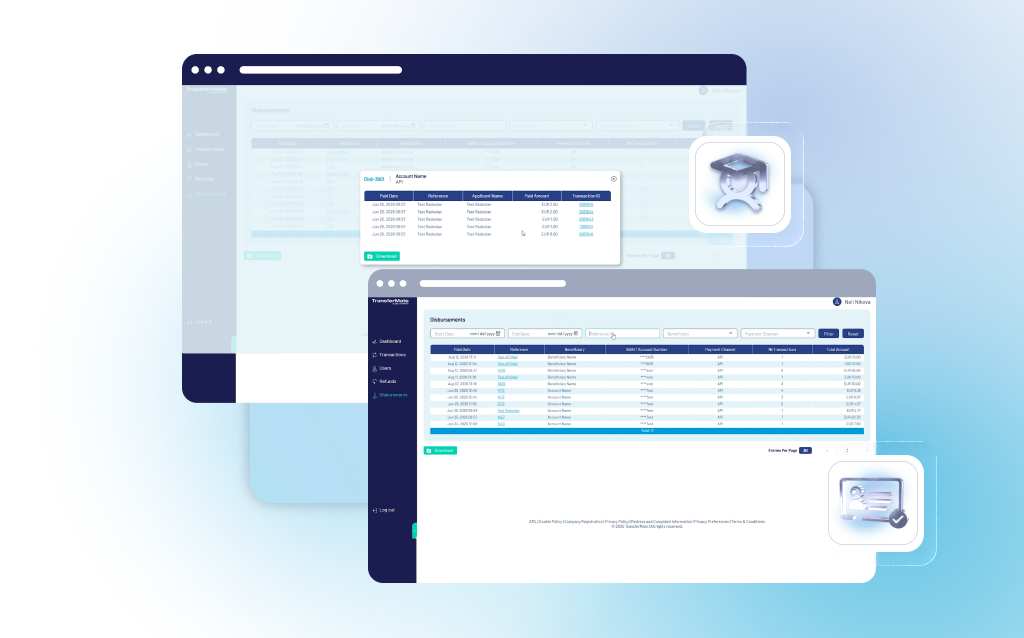
TransferMate Education API Dashboard Update: Disbursements Visibility

TransferMate and Serrala Partner to Bring Global Payments into Finance Automation Workflows

Turning Receivables into a Strategic Asset
In a world of global supply chains, distributed customers, and cross‑border growth, currency volatility has become an unavoidable cost of doing business. Exchange rates move constantly, driven by interest rates, geopolitics, and macroeconomic forces that sit far outside the control of any individual organization.
Yet for many businesses, the true risk isn’t volatility itself. It’s uncertainty.
When a future payment or receipt is exposed to currency movements, finance teams are left planning in ranges rather than numbers. Margins become estimates. Forecasts require caveats. And decisions are delayed, not because opportunities aren’t clear, but because the outcomes aren’t.
This is where FX forwards earn their place as a strategic instrument for certainty.
Many businesses still manage foreign exchange reactively. A payment is due in three or six months’ time, and the assumption is that the rate on the day will be “good enough”.
Sometimes it is. Sometimes it isn’t.
The challenge with this approach is the operational drag it creates. Finance teams are forced to monitor markets, explain variance after the fact, and absorb unexpected currency impacts that were never part of the commercial decision‑making process.
Whether it’s a supplier payment becoming more expensive or anticipated revenue coming in less than expected, the result is the same: your margins are being eaten into.
Over time, this creates a disconnect; teams make commercial decisions based on one set of assumptions, then settle them under entirely different conditions.
FX forwards exist to close that gap.

At their core, FX forwards allow a business to separate commercial decisions from currency movements.
By locking in an exchange rate today for a transaction that will settle in the future, organizations gain clarity over what a deal will cost or deliver in their base currency - regardless of how markets move in the interim.
Consider a simple, real‑world example.
A European business knows it must pay a US supplier $1 million in six months’ time. At today’s spot rate, the euro cost appears manageable - but six months is a long time in FX markets. A weakening euro could increase the cost of that payment, eroding margins that were already agreed with customers.
By entering into an FX forward, the business fixes the exchange rate today. The euro cost of the future payment becomes known and immovable. If the euro weakens, the forward protects the business from having to pay more. If the euro strengthens, the business doesn’t benefit from the upside, but that was never the goal.
The same principle applies on the revenue side. When a business expects to receive foreign currency from customers, locking in the future exchange rate helps protect the value of that revenue when converted back to the base currency.
The goal on both sides is the same. Certainty.

Certainty is often underestimated as a source of value.
When exchange rates are fixed in advance, finance teams can forecast accurately. Budgets become dependable. Pricing decisions are made with confidence rather than in a contingency plan. Cash‑flow planning improves, not because markets are calmer, but because exposure is controlled.
Crucially, when both payables and receivables are managed proactively, margin ceases to be a variable outcome and becomes a controlled input.
This is particularly important for businesses operating at scale. As transaction volumes increase, even small currency movements can have outsized effects on the bottom line. FX forwards allow those effects to be neutralized, turning currency from a variable into a known quantity.
In this sense, FX forwards are not about predicting markets. They instead remove markets from the equation altogether.

Of course, an FX forward on its own is only part of the picture.
Forward contracts introduce considerations around settlement, collateral, and counterparty risk. When a rate is locked in today for settlement months in the future, one party will inevitably be “in the money” and the other “out of the money” as markets move. Managing that exposure responsibly requires margin, controls, and infrastructure.
This is where execution and integration become critical.
For businesses, the value of FX forwards increases dramatically when they are embedded into the same environment used for payments, collections, and treasury operations. Hedging exposure at the transaction level, rather than in isolation, allows finance teams to align risk management directly with cash movement.
Instead of juggling multiple systems, providers, and timelines, FX forwards become part of a single, coherent workflow.

The real strategic value of FX forwards emerges when they are applied across both sides of the balance sheet.
On the payables side, businesses can lock in the cost of future supplier payments, removing the risk of adverse currency movements that would increase input costs.
On the receivables side, they can secure the base-currency value of expected customer payments, protecting revenue against unfavorable exchange-rate movements.
Individually, each approach reduces risk. Together, they create end-to-end visibility and control over margin.
This alignment allows finance teams to move beyond managing isolated exposures and instead protect the full commercial lifecycle of a transaction, from agreed pricing to supplier settlement to final revenue recognition.
In practical terms, this means the margin agreed at the outset is the margin delivered at completion.
The most forward‑thinking organizations treat FX forwards as a strategic capability.
They review exposure regularly, hedge predictable cash flows rather than reacting to market volatility, and align FX strategy with business planning cycles rather than market headlines.
In practice, this might mean using forwards to secure budget rates for future supplier payments while also protecting expected foreign-currency revenues to maintain forecasted margins.
It may involve layering hedges over time or using forward‑forward structures to manage rolling exposure.
What matters is not the sophistication of the instrument, but the intent behind it: to bring discipline and predictability to international finance.
The foreign exchange environment is unlikely to become calmer. Interest rate divergence, geopolitical uncertainty, and fragmented global growth mean volatility is here to stay.
In this context, the question for businesses is no longer whether currency risk exists, but whether it is being managed deliberately or left to chance.
FX forwards offer a clear answer. They don’t promise better rates. They don’t speculate on direction. They simply provide certainty. And in doing so, they allow businesses to focus on what they do best: growing, investing, and operating with confidence across borders.
For organizations navigating international expansion, that certainty is a strategic advantage.
For more information on FX forwards and TransferMate’s Broker Hub offering, contact our team today.
We simplify, digitize, and automate the manual tasks involved in paying and getting paid.