Category
Payables & Receivables
June 3, 2026


Latest from the Blog
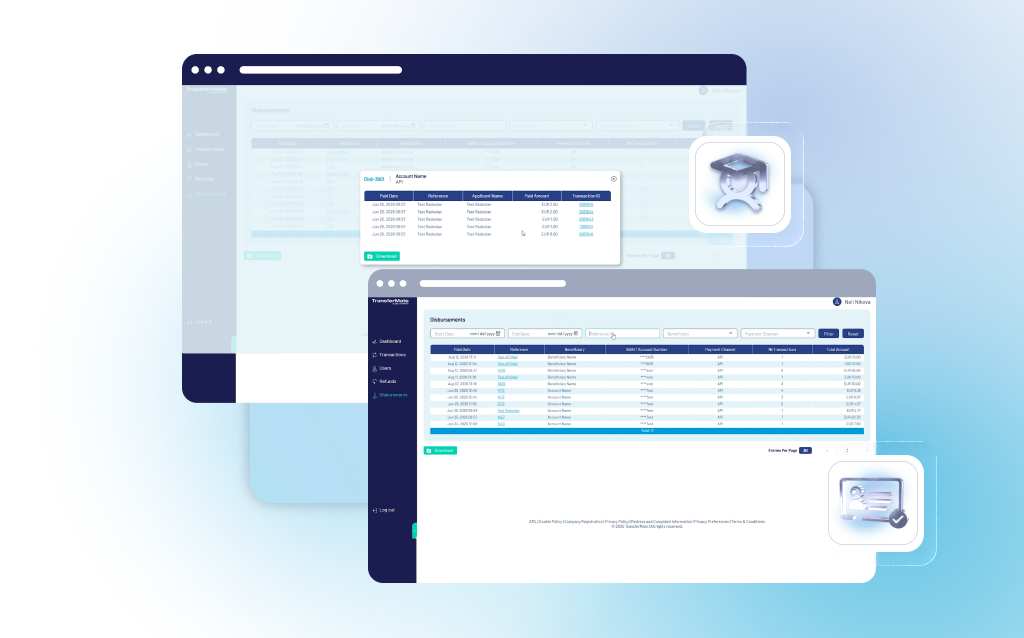
TransferMate Education API Dashboard Update: Disbursements Visibility

TransferMate and Serrala Partner to Bring Global Payments into Finance Automation Workflows

Turning Receivables into a Strategic Asset
Managing exposure to the foreign exchange (FX) market is a critical challenge for businesses operating internationally.
Currency volatility affects profit margins, cash flow forecasting, and long-term financial planning. One of the most effective and widely used tools for managing foreign exchange risk is the FX Forward, also referred to as a forward contract or foreign exchange forward contract.
This guide explains what FX Forwards are, how they work, and the key benefits they offer businesses seeking certainty, control, and transparency in their international currency strategy.

An FX forward is a legally binding agreement between two parties to exchange one currency for another at a fixed exchange rate on a future date, usually anytime from one week to a defined maximum.
Unlike spot FX transactions, where currencies are exchanged on the same day or shortly after, forward currency exchange allows businesses to lock in today’s rate for a transaction that settles at a later date.
FX forwards may also be described as:
While terminology varies, the purpose remains the same: reducing exposure to currency movements and ensuring certainty for financial forecasting.

A forward transaction is any foreign exchange deal where settlement takes place on a future date, typically from a few days to six months ahead; however, under agreement, these contracts can be negotiated for up to and beyond a 12-month period.
Forward transactions are commonly used to manage predictable future exposures, such as:
For businesses with known cash-flow timelines, FX Forwards offer structure and predictability that spot transactions cannot provide.
When a business enters a forward exchange, the FX provider calculates the rate using the current spot exchange rate, the interest rate differential between the two currencies (i.e., the gap between how much you can earn (or pay) in two different currencies) and the length of the contract (this is known as the tenor).
This produces a fixed forward contract exchange rate that will not change, regardless of future market movements.
More advanced structures, such as “flexible FX forwards”, allow businesses to hedge multiple future dates or extend the forward's tenor as requirements evolve, supporting long-term foreign exchange rate management strategies.
Currency markets are inherently volatile.
FX forwards remove uncertainty by fixing the rate in advance, allowing businesses to protect their profit margins and stabilise costs against unpredictable exchange rate volatility.
This makes them a cornerstone of effective FX risk management and currency risk management frameworks.
The primary benefit of FX forwards is protection against foreign exchange risk.
By locking in exchange rates, FX forwards provide certainty over future cash flows. Finance teams can forecast figures with confidence, knowing exactly how much a future transaction will cost in their base currency.
This is particularly valuable for:

The foreign exchange market is influenced by global interest rates, geopolitical events, and economic data, many of which are impossible to predict.
FX forwards allow businesses to step away from day-to-day volatility, avoiding the need to monitor markets or time the market.
This differs fundamentally from speculative FX trading or online forex trading, which is not designed for corporate risk mitigation.
Rather than being an exercise in cost saving for a business, using FX Forwards acts as a method to manage risk and bring future certainty to planned operations.
FX forwards also provide greater pricing transparency than repeated spot transactions. Understanding the FX spread (the difference between buy and sell prices) is essential when evaluating costs.
Businesses often ask, “What is a good spread for forex?” The answer depends on the currency pair, transaction size, and provider.
FX Forward contracts can often be tailored with features such as:
• Partial drawdowns: Allows the client to draw down the forward contract in smaller amounts over time, rather than settling the full value in a single transaction.
• Early settlement: Gives the option to settle the contract before its original maturity date, helping clients adapt to changes in cash flow or payment timing.
• Extensions or rollovers: Enable the maturity date of the forward contract to be extended, maintaining certainty when underlying payment dates are delayed.
This flexibility makes FX forwards suitable for real-world business cash flow patterns, rather than rigid, one-off transactions.
FX forwards are most effective when used as part of a broader foreign exchange rate management approach.
Providers like TransferMate support this by combining FX Forward capabilities with global payment infrastructure, helping businesses manage currency exposure alongside international payments on a single platform.
For more information on FX forwards and TransferMate’s Risk Management offering, contact our team today.
We simplify, digitize, and automate the manual tasks involved in paying and getting paid.