


For global organisations running SAP software, payments are rarely the headline item in a transformation programme, until they become the bottleneck.
The reason is simple: payments tend to grow incrementally until they become a problem.
An entity launches in a new country and establishes a local bank for collections. A new regional treasury team adopts its preferred payments partner, bringing new payment rails and file formats. Rinse and repeat for each new expansion, and over time, what started as “just one more bank connection” becomes a complex and fragile architecture.
The result? Payments may still flow, but the operating model behind them is far from optimal.
The Hidden Complexity in SAP Banking Infrastructure
As businesses expand internationally, banking infrastructure is often built in layers, making bank connectivity complex for unavoidable reasons.
- A host-to-host connection is added for one region
- A SWIFT channel supports another set of banks
- Portals are used where integration isn’t feasible
- Different local file formats persist because “that’s what the bank requires.”
It works, but it introduces operational and technical drag. And that drag shows up in familiar ways.
Multiple bank integrations mean multiple points of failure. Each interface has its own security requirements, mapping rules, testing cycles, and maintenance overhead.
Meanwhile, finance and treasury teams are affected by fragmented transaction reporting, inconsistent settlement timelines, and unpredictable fees. This delayed visibility into cash movement is a hurdle, and with labour-intensive reconciliation work, admin hours rack up.
At a certain scale, one question always rises to the top.
Is there a simpler way to connect SAP to the global banking ecosystem, without adding more host-to-host infrastructure every time the business changes?
Multi-Bank Connectivity Solves Connectivity, But Execution Still Matters.
Even with SAP Multi-Bank Connectivity in place, many organisations still rely on multiple banks to execute payments across regions.
This means the connectivity layer may be centralised, but execution remains fragmented:
- settlement timelines vary by corridor
- transaction status updates are inconsistent
- payment data differs across rails and providers
- reconciliation files arrive in different shapes and schedules
And that fragmentation limits how far standardisation can go.
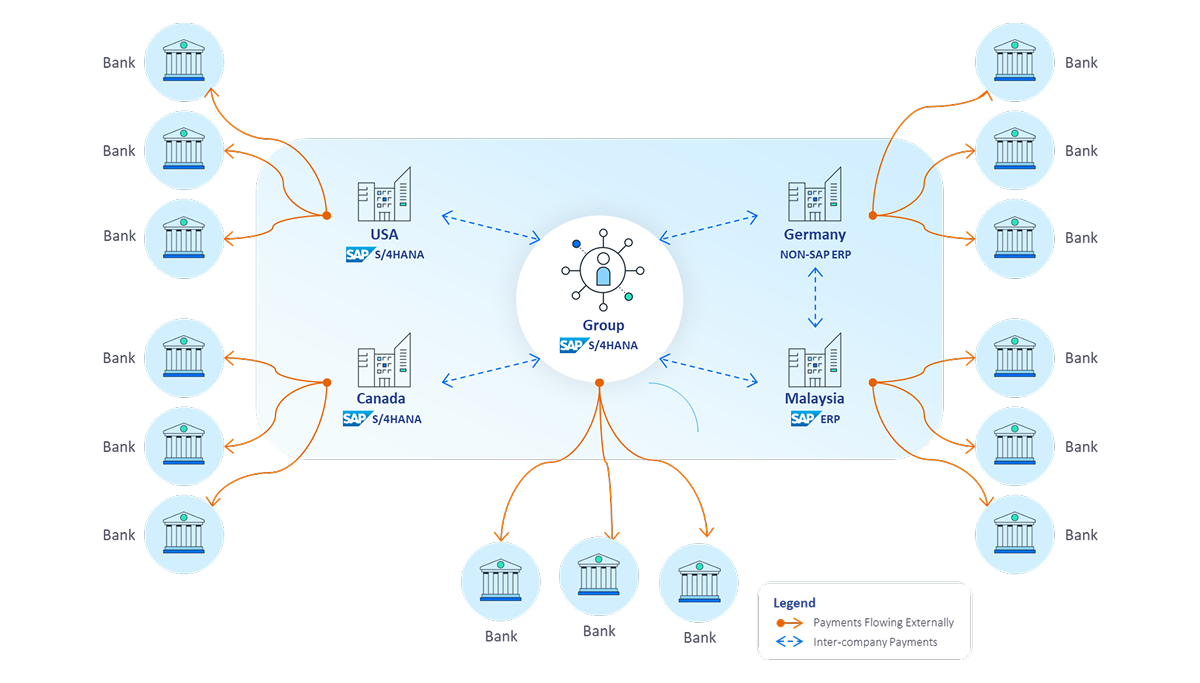
Because SAP Multi-Bank Connectivity can centralise message transport, the enterprise still has to manage the complexity of multiple execution partners, each with its own networks and cost structures.
This is where the next evolution emerges.
The Emerging Model: SAP Multi-Bank Connectivity with a Single Global Execution Partner
What if all those member banks and host-to-host connections could be consolidated? We could discover a reality in which SAP manages payments, SAP Multi-Bank Connectivity manages connectivity, and a single member bank manages global execution across every payment.
If connectivity is standardised, execution should be too.
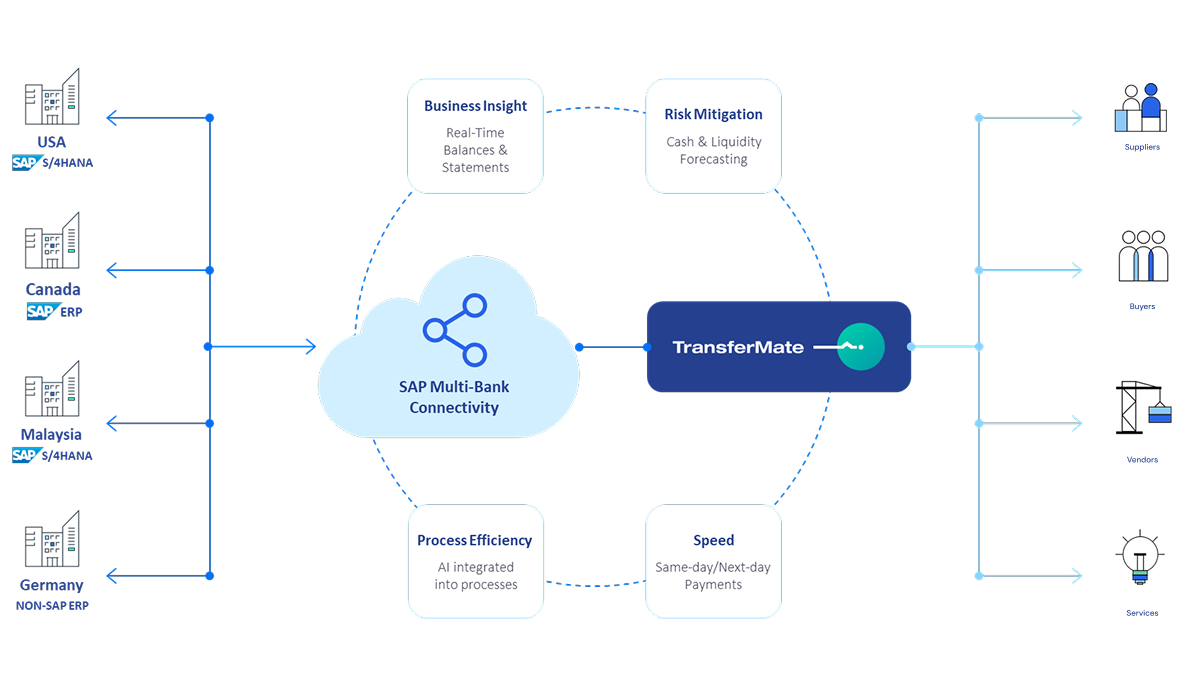
In practice, a single execution partner model can help SAP customers reduce variability across:
- payment rails
- fee structures and foreign exchange (FX) handling
- transaction reporting and confirmation flows
- reconciliation inputs back into SAP
The result is a payments environment that behaves more like a cohesive platform.
How SAP Multi-Bank Connectivity Works with TransferMate
One example of this single-partner model is integrating TransferMate via SAP Multi-Bank Connectivity as a member bank, where SAP Multi-Bank Connectivity acts as the hub for payment initiation and message exchange, and TransferMate executes payments through its extensive global network.
The structure is intentionally simple:
SAP Software connects to SAP Multi Bank Connectivity, which connects to TransferMate, and TransferMate executes payments across its global network of over 200 countries and territories in more than 140 currencies.
Within this structure:
- SAP remains the system of record for payment initiation and financial processes
- SAP Multi-Bank Connectivity provides a secure channel for bank communications
- TransferMate acts as the execution partner, with transaction data flowing back into SAP for visibility and automated reconciliation
1) Eliminating the Burden of Multiple Host-to-Host Integrations

One of the most immediate advantages of a single execution partner model is what it removes: the ongoing burden of maintaining multiple host-to-host connections and bank-by-bank variation.
In a typical multinational setup, each additional entity and bank can introduce a new integration requirement, and those connections must be tested, maintained, and revalidated over time.
By routing payments through SAP Multi-Bank Connectivity and a single execution partner, such as TransferMate, organisations can shift toward a single connectivity framework with less maintenance exposure and simpler onboarding as the business expands.
2) Improved Treasury Visibility and Data Consolidation Inside SAP

Fragmented payment execution creates fragmented data.
When different banks execute transactions across regions and rails, reporting is distributed and inconsistent, making it harder for the treasury team to see global cash movement clearly, quickly, and in a standard format.
Centralising payment execution through a single partner, while keeping SAP Multi-Bank Connectivity as the messaging hub, enables transaction confirmations, payment status updates, and reconciliation files to flow consistently back into SAP.
In short, the treasury team spends less time gathering data and more time using it to achieve stronger reporting consistency and improved liquidity insights.
3) Faster Cross-Border Payments and Better Working Capital Control

Traditional cross-border payments often involve multiple intermediary steps, adding time, cost, and uncertainty.
Settlement times can be slashed from the 2-7 working days it can take with traditional payment rails to same-day or next-day on most corridors.
That speed has direct treasury implications. It reduces the need for large cash buffers, improves payment predictability, and offers better control of when cash leaves the organisation
For enterprises operating at scale, even small improvements in payment velocity and predictability can translate into meaningful working capital benefits.
4) Automated Reconciliation and Reduced Operational Risk

Reconciliation is where payment complexity becomes operationally expensive.
When bank execution is fragmented, reconciliation formats often vary by bank and region, which increases manual handling and the likelihood of exceptions.
A standardised SAP Multi-Bank Connectivity flow with a single execution partner is designed to return consistent status and statement messaging to SAP, enabling automated posting and matching against accounting documents.
The outcome is fewer manual touchpoints, lower operational risk, and a payments operation that scales without requiring proportional headcount growth.
Why This Model Matters for SAP Partners and System Integrators
This trend matters not only for SAP customers but also for the SAP partner ecosystem.
Partners are increasingly supporting clients through S/4HANA migrations, treasury transformation programmes, and global standardisation efforts.
In these programmes, bank connectivity is often one of the most complex and risk-prone workstreams, precisely because it touches external institutions, security processes, and bank-specific variation.
A model that centralises connectivity through SAP Multi Bank Connectivity while standardising execution through a single partner reduces delivery friction and simplifies long-term support.
It also aligns with the broader platform direction in enterprise finance: fewer bespoke integrations, more standardised services, and more automation built into the process layer.
The Future of SAP Treasury and Payments
Treasury expectations are rising fast. Organisations increasingly need automation, reduced operational risk, and scalability.
SAP Multi-Bank Connectivity is a foundational step in that direction, providing a standardised communications hub between SAP systems and financial institutions.
But to unlock the full value, the market needs to standardise execution, consolidate the number of payment partners where possible, and adopt a model that behaves like a unified global payment layer.
With SAP Multi-Bank Connectivity for connectivity and TransferMate as the execution layer, companies can achieve just that.
For more information on SAP Multi-Bank Connectivity and TransferMate’s execution layer, contact our team today, or learn more about our integration on SAPs website.